An Inheritance of More than Books
So many events in history can seem like they happened a long time ago and don’t have any relevance for us today. The Civil War was one of those events for me until recently when I opened boxes of my grandfather’s books and discovered a thread of stories and convictions that connect me more to that war than I ever realized.
When I was a child, I was aware that my Grandpa Peterson’s hobby was tracing the paths of the men from Minnesota who served in the Civil War. This was way before the Internet. His small bedroom was lined with shelves bulging with ancient looking books. He and my grandmother took car trips to cemeteries in the south looking for soldiers’ gravestones to confirm their final resting places.
They took me on a couple of these trips when I was quite young. I mostly remember the sugar packets stamped with different states in roadside diners and souvenir shirts with a map and the name of a city. I remember wearing Galenia, Illinois. My most vivid memory is of being in a cemetery while my grandparents looked for a specific headstone. Grandma had walked back the direction we had come and drove the car closer as we made our way across a large cemetery. She must have forgotten to set the parking brake, and the car began slowly rolling down an incline. I did not know that my grandfather could run until I saw him chase that car.
Wanting to share his love of history, my grandfather gave me a subscription to American History Illustrated magazine for many years after I learned to read. The color images were impressive, and I skimmed the articles, but at the time I didn’t connect with the content like he did. My only other exposure to the Civil War was in junior and senior high school when the war was reduced to a list of dates and battles, all men. Studying the war was more an exercise in memorization rather than an exploration of the deeper issues confronting our young nation.
Grandpa died in 1980 at eighty years old. I was in college. After my grandmother died a few years later, my father packed up the Civil War books and stored then in closets and the attic of my parent’s home. After he died and my mother moved into a house with a bedroom on the main floor, we moved the books into her basement. Mom died two years ago, and my daughter moved into that house with the books still in the basement.
Recently, I opened the boxes and looked through the books, still holding my grandfather’s bookmarks, often tissues, and his notes, sticking up between the pages. I also found a newspaper article from 1965 with my grandfather, sitting around a table at the county historical society. The group included physicians, an attorney, businessmen, and other community leaders. All the men except for my grandfather wore suits. He sat among them wearing a buttoned-up dress shirt, a successful small businessman whose formal education ended at eighth grade. The occasion was the first meeting of the Civil War Roundtable at the Olmsted County History Center.
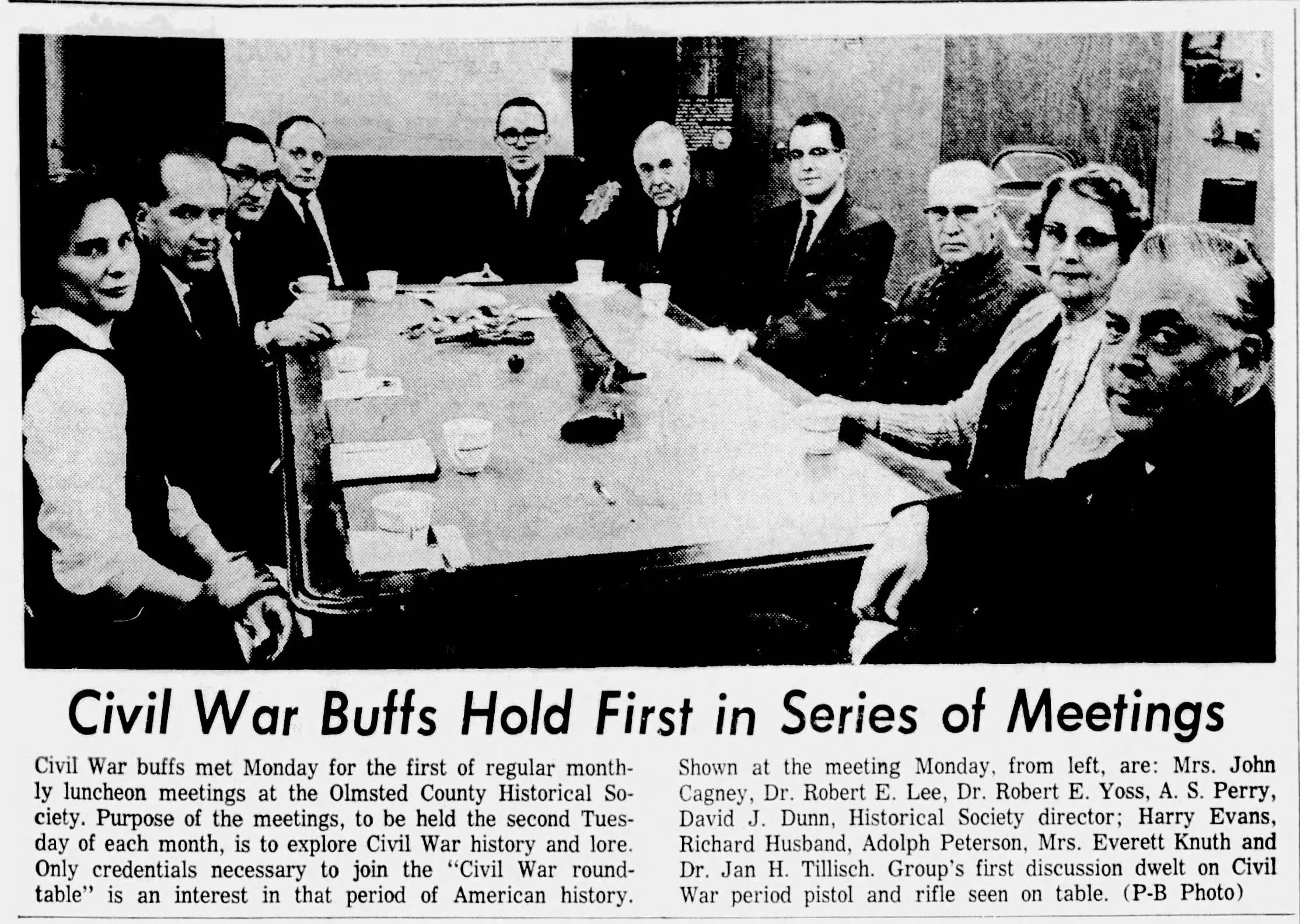
Rochester Post Bulletin
Another newspaper article I found was written just a few years before Grandpa died. From that article, I learned that his interest in the Civil War began when as a boy he worked for a local farmer, a Civil War veteran who had fought in the Battle of Bryce’s Crossing in Mississippi. He was captured and incarcerated at Cahaba prison camp in Selma, Alabama. According to the article, the experience hearing the veteran’s stories shaped my grandfather’s psyche. He and my grandmother were reported to have visited more battlefields, cemeteries, and prisons than most historians, sometimes with a young child in tow. His book collection totaled two hundred volumes at the time of the article.
I feel badly that the books have been boxed up for over forty years. My granddaughter and I pulled them out and listed them on a spreadsheet, including Minnesota in the Civil and Indian Wars 1861-1865 Vol 1 & 2 (1890) and Life and Death in Rebel Prisons (1866). There were books about slavery and women: Slavery and the Slave Trade (1861) and Pictorial Book of Anecdotes of the Rebellion with Famous Words and Deeds of Women (1888).
I am just now realizing how deeply I was impacted by my grandfather’s interest in the Civil War. The war isn’t a distant event that only exists in high school history classes or dusty books. I can now connect my respect for enslaved people and their descendants, in part, to bits and pieces of conversation I overheard as a child when my grandfather talked about what he learned from the veteran who hired him, those books, and walking the graveyards, battle fields, and prison grounds. I am also seeing that my attitudes and opinions about the origins of some of our current political dynamics relate to unresolved issues steaming from the Civil War.
To some extent, I feel like a monarch butterfly who inherits the migration route from its ancestors, almost by osmosis, I inherited a sensibility from him, my other grandparents, and my parents that guides me today. How else could I have ended up so fascinated with powerful stories of the past and written four books of history? I am deeply grateful.
Oh, and the books . . . my daughter, grandchildren, and I boxed them up this week, and on behalf of the Peterson family, we donated them to the History Center of Olmsted County, which still hosts the Civil War Roundtable. If you would like to see them, just ask for the Adolph Peterson Collection of Civil War Books. I think Grandpa would be happy to know that his books will be preserved and available for future generations and that his legacy of seeking and sharing powerful stories from the past endures.
© 2026 Virginia Wright-Peterson